

by Gordon MacDonald •
There are many facets of fishing for the different angling targets, techniques, locations and approaches. Most anglers strive to be the best they can, whilst enjoying this sport and possibly providing fare for the dinner table. No matter how long you have been an angler, you can still learn from others.
There are many small attributes that can be adjusted to can make your experience on the water rewarding and to improve results. Having been a tackle salesman for over 25 years there are a lot of questions that get asked of me with regularity. This issue I will share with you a few insights based around these questions and offer some simple ideas and nuances that can improve your angling experience.
CIRCLE HOOKS
Many anglers have heard of circle hooks however they know little about the best way to use them or even when to use them. Circle hooks were originally the product of early fishermen. Historically it was the Japanese who tied pieces of reindeer horn together in the shape of a circle hook. Native Americans also used hooks similar to the modern circle hook, which were honed from bone, horn or wood. This shape, with the point perpendicular to the shank, was found to hook fish well without the need for an angler to jerk on the line to set the hook. The fish would swallow the baited hook then begin to swim away. As tension increased, the hook would naturally move to the lip or corner of the mouth with the point resting against it. The changing direction of the fish caused by tension would make the hook roll and penetrate the jaw area offering a secure hookup. Such a hookup lessens the chance of the mouth or teeth abrading the leader. It makes it easier to release unwanted fish and also minimises damage to the fish, which goes a long way to guaranteeing survival rates. Due to working in this manner, circle hooks are ideal for any situation where the angler is not waiting for a bite to strike at the fish and set the hook.
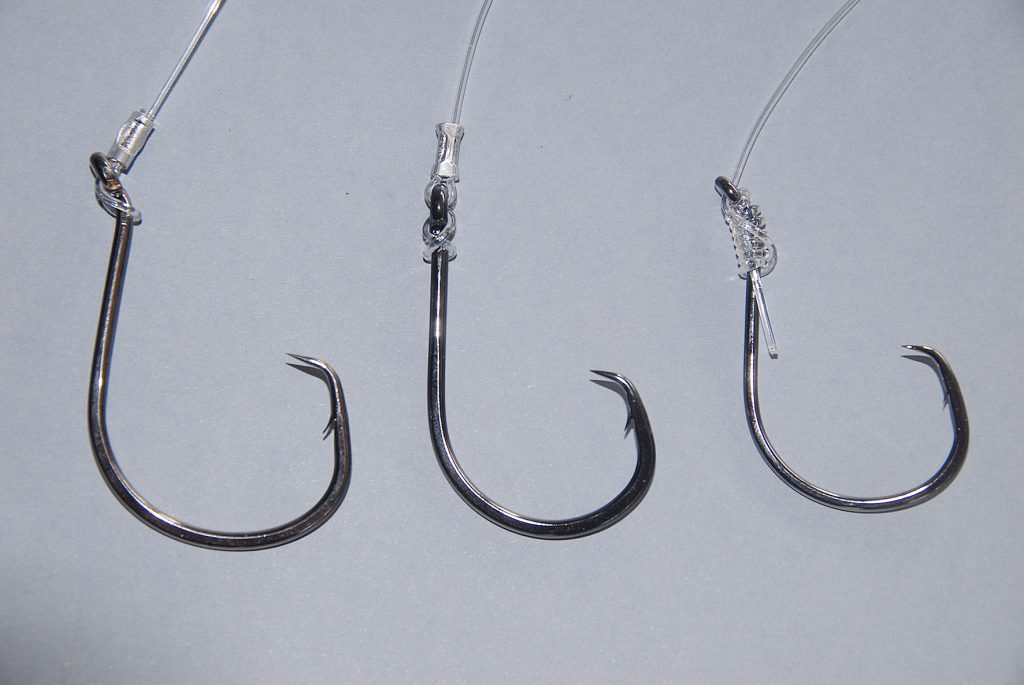
Commercial fishers use circle hooks on set lines and long-lines as they are not in attendance to drive the hook home when a fish takes the bait. If you are fishing with the rod in the holder or in a situation where you aren’t going to strike at the fish, then circle hooks are ideal. I use circle hooks regularly for live baiting pelagic species such as marlin, cobia and tuna however they can work well on snapper, pearl perch and most other species.
One tip I have to offer when using circle hooks is to create a stiff connection between the leader and the hook. This will assist the hook to set well and also eliminate the chance of the hook fouling with the leader. Pass the leader through the hook eye, wrap it around the hook shank and then back up through the hook eye before securing with a knot or crimp. Once a fish takes a baited circle hook, you can wind the reel handle or just allow the tension to take up. However, you must never strike with the rod or you will most likely rip the baited hook from the mouth entirely. Circle hooks work exceptionally well when rigged correctly and used properly. Once you hook up you will rarely have a circle hook pull free.
LURE LEADERS
Anglers will generally put a heavier leader between the lure and the main line to avoid being chaffed off if a large fish swallows the entire lure. Also if a hooked fish runs directly away from the angler, the tail and body protrusions (including gill-rakers) will damage the line. A leader (which has greater abrasion resistance than the main line) greatly decreases the chance of losing a fish due to wear over a long fight.

Your leader can be made from materials such as monofilament, wire (either multi-strand or single strand) or fluorocarbon (which neither attracts nor reflects light making it low visibility in the water). Which leader material you utilise will depend on the target species and fishing situation. For easily spooked species or hard fished areas, a fluorocarbon leader is the best option. Toothy critters such as mackerel, wahoo and sharks often dictate the use of wire leaders. For fishing the deeper water (where minimal light penetrates), a monofilament leader will suffice. One tip I have for you when using leaders is to use as light as you dare and minimise extra attachments such as swivels and snaps.
Learn to attach a monofilament or fluorocarbon leader to the main line using a knot (FG, albright, slim beauty etc.) instead of a swivel. This will be lower visibility and allow you to wind the leader through the rod tip without damaging the insert. Attaching the lure to the leader can be done in several ways. Many will use a snap swivel however I prefer to eliminate this and opt for a loop knot (Lefty loop, perfection loop). Wire can be crimped directly to the towing eyelet of a lure. If using pre-made traces, I recommend taking the snap off and attaching the loop formed in the wire directly via the split ring to the towing eyelet. Most snaps are offset to one side therefore discarding them and connecting the leader directly to the lure will allow the lure to run truer. This will definitely increase the speed at which a lure can be trolled without it blowing out.
TACKLE CARE
Quality tackle isn’t cheap these days so it pays to look after it carefully to increase your pleasure of using it and decrease the pressure on your budget. Warm soapy water will help to remove salt from your rods and reels after a day on the water. Never submerge a reel in water of any kind. Simply dribble water over it or lightly spray it to remove the salt and soap.
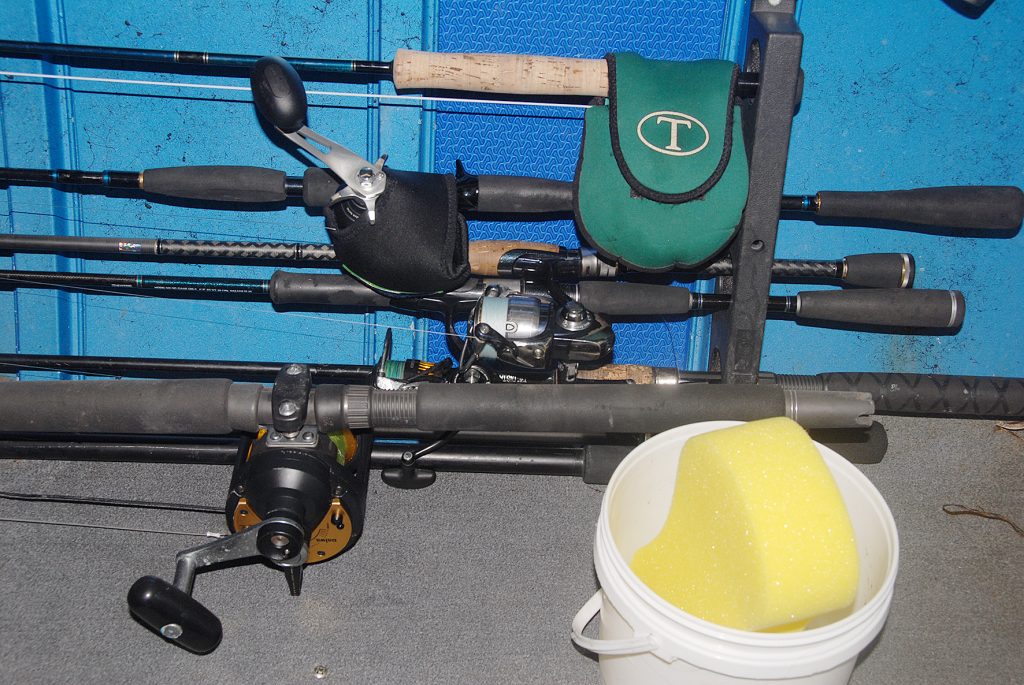
Putting neoprene reel cover over reels during transit will minimise scratching and the ability for salty water and other debris to enter the reel. Avoid transporting rods in rod holders that are getting soaked with salt spray as you travel. These rod holders are usually the rear corner ones but this will depend on your boat setup. If travelling with rods in overhead rocket-launchers, use an occy strap (or similar) to prevent the rods moving around or even falling out of the holders totally. A little lanolin can be wiped over the outside of your reels to help water roll off and decrease permeation. It is advisable to spray it onto a cloth then wipe it onto the reel. Once you have rinsed your spinning reels, they should be allowed to dry fully whilst in a horizontal position as this will allow the water to drain off easier instead of being trapped in grooves and crevices.
My rods are stored lengthways (horizontal) in my boat that offers the ideal position for both overhead and spinning reels. This puts them in the perfect position for water to drain away whilst they dry. I regularly leave them in the rod racks after I have washed them. A bit of oil on the line roller every few trips should keep it moving freely. Cast nets should be soaked well in fresh water after use to ensure both the net and rope are salt fee once dried and stored away.
CORROSION PREVENTION
Saltwater is very harsh on all tackle. Hooks, tools, lures and knives of any metal can corrode once they come into contact with salt water. Stainless steel comes in many grades and as the name suggests it ‘stains less than normal steel’ but is still not corrosion free in most cases. Spot rust is still a high likelihood with most grades of stainless steel. There are numerous ways to stave off the corrosive effects of saltwater.
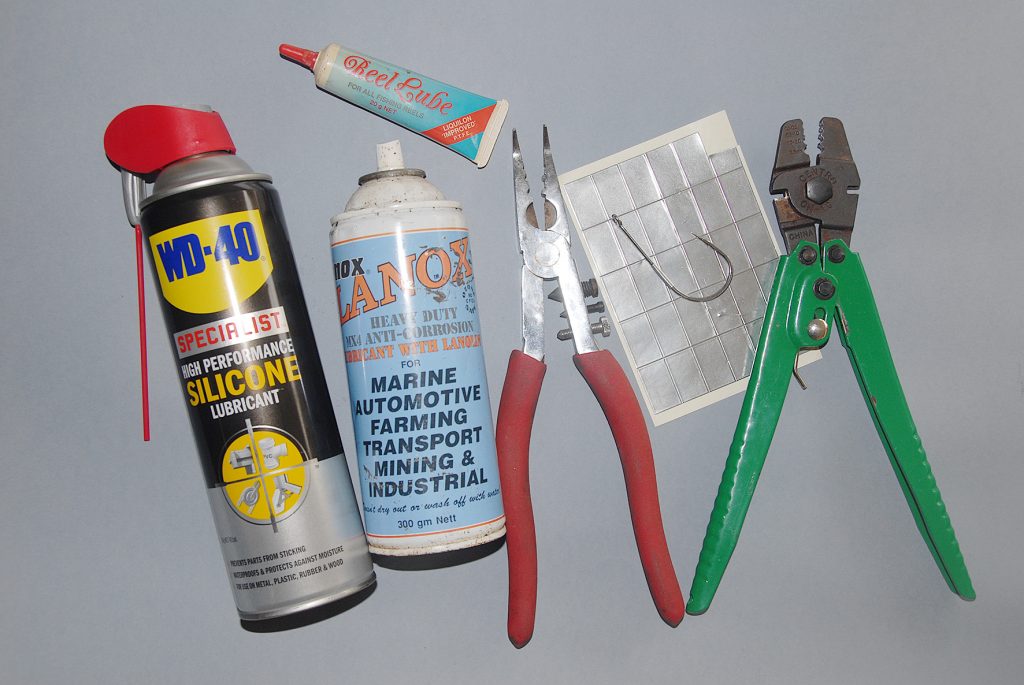
Regular cleaning and lubrication is the best bet but if you’re like me and regularly forget them the job is made a lot more difficult later on. Products like WD40, Tackle Guard and ProTECta Spray Lube can all be used to free up box joints on pliers and pin joints on scissors and other tools.
Ensure you clean your knives well where the blade comes out of the handle as this is an area where blood often builds up and corrodes the blade. A couple of tips I have picked up over the years that are as follows. When lure fishing, I often have a plastic screw-top jar with some fresh water in it. When I take a lure off my line I will drop it straight in the jar and put the lid back on. This immediately removes excess salt water and also avoids hooks becoming embedded in carpet or skin. Once home I will remove the lures and hang to dry.
Anode tape is great for avoiding rust on metal. This zinc tape serves as an anode for the steel which significantly reduces the spreading of corrosion. I use this on some tools and also on my larger game hooks. It will also stop the points of chemically sharpened hooks becoming brittle due to the effects of electrolysis when trolling. Small strips of anode tape can be added to the compartments in your tackle box to reduce corrosion.
Many tackle boxes are now available with rust prevention additives. A small bit of prevention can go a long way to increasing the life of your valuable tackle.
CATCH CARE
We all put a lot of time and effort into catching our target species. Many anglers chose to carefully release most of the fish that they catch. Some however, me included, love to take a feed of fish home for the family. While many just open the esky lid and deposit their fish, prawns or crabs in there, better care will increase the flesh quality of your seafood.
A dying fish thrashing around in the esky is not only inhumane, it will also cause bruising to the flesh and a build-up of lactic acid and cortisol which lowers flesh quality and makes it age (spoil) faster. Dispatching the fish immediately by iki jime (spiking the fish in the brain) or cutting the spinal cord is highly recommended.
Next the fish should be bled by cutting the gill latch or partially removing the head. Tuna bleed out well when you stab them just behind the pectoral fins with a blade as this is where a major artery is. Once the fish is bled, adding them to a slurry (ice combined with salt water) will help them to chill down quickly. An ice slurry is also ideal for prawns and crabs. Look after your catch well and you will notice an improved quality in the flesh and taste.
These are just a few little tips that will help to improve your results plus look after your tackle and catch. Ultimately this will improve your enjoyment of our great sport and save you a few bucks along the way.


