
by Gordon Macdonald •
As the Murray cod season has been open for over a month and with the barramundi season due to re-open on 1 February at midday, I thought I would tie a pattern ideal for both species utilizing some relatively new materials on the market.
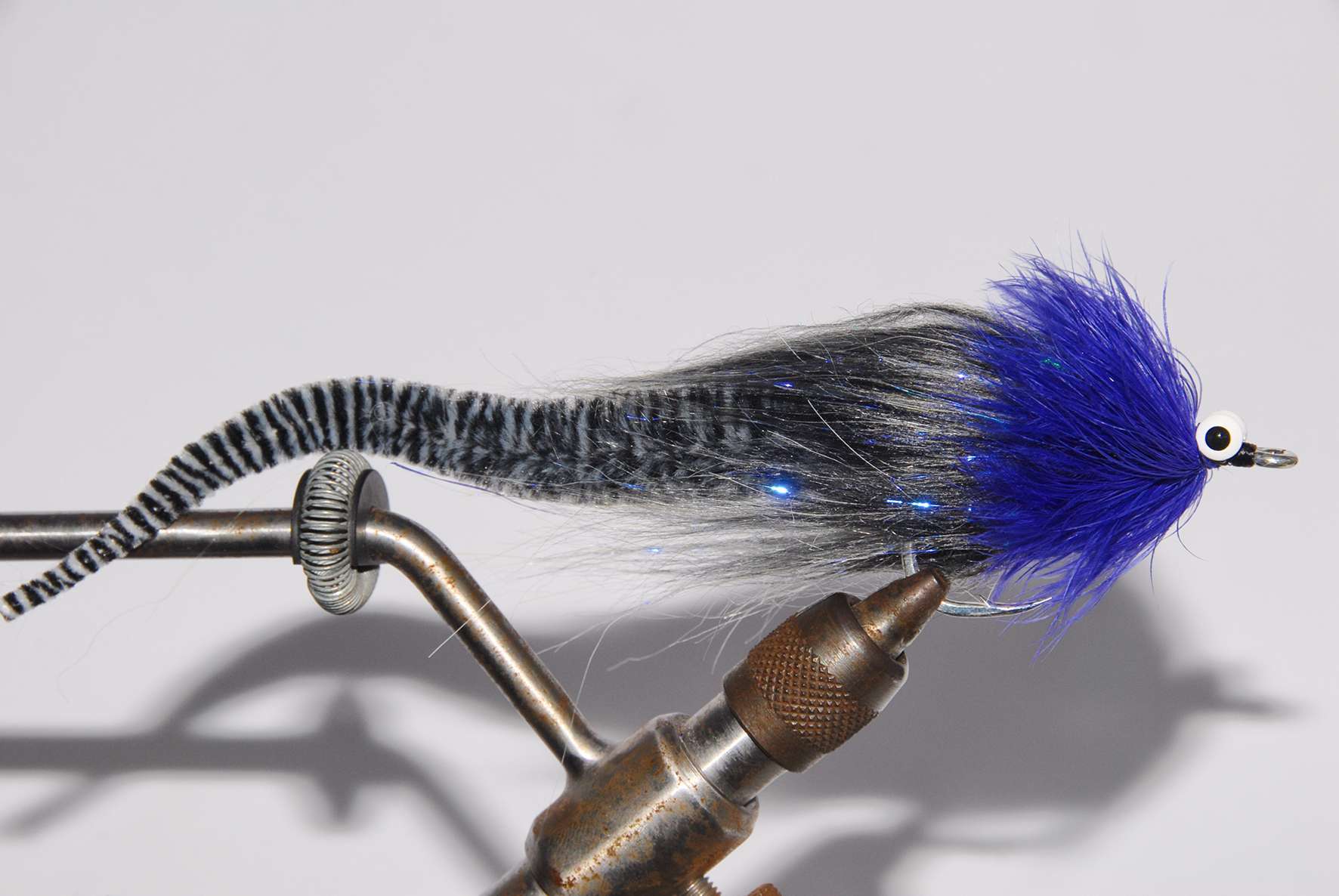
There are a lot of variations in this pattern and it has numerous names depending on the variation of materials from which it can be tied with. I simply call this one the Brush Dragon after the two most prominent materials it is tied with. This pattern has heaps of action in the water and actually appears to be swimming due to the snake like tail action the dragon tail produces during the retrieve.
David Mangum’s dragon tails are distributed by Orvis (Mayfly Tackle) in Australia and available in 11 straight colours in the 9” size and ten colours in the 6” size (including five variegated colours). When tied into a fly where the head is larger than the tail, a natural vortex is created that helps the tail swim in a snake like manner. Obviously more action is imparted with the stripping technique, yet even on the sink the pattern has an enticing action.
The whistler style head obviously pushes a degree of water and this fly has real presence in the aquatic environment. It will catch an array of larger predators including barramundi, Murray cod, trevally, tuna, threadfin salmon, mulloway, mackerel and numerous others.
The other exciting material in this pattern is the Just Add H2O Polar Fibre Streamer Brush (distributed by EJ Todds). This material is a brush version of the original Polar Fibre with added flash. There is a great array of flat and variegated colours in the 3” brush that can be matched with the various dragon tails. Additionally there are numerous other brush types that could be used in this pattern including Streamer Brush, Lively Legs Brush and Baitfish Brush.
I have gone old school with the collar and utilized saddle hackles, however, zonker strips, palmer chenille, marabou and CCT Body Fur could all be used to create slightly different effects. Obviously there are a lot of variations in colours for this pattern, however, the basic tying principle remains. This fly can even be tied as a variation of the pink thing, with white body and pink collar, which is one of the most popular barramundi flies of this nation. However, the variations are endless and up to your imagination.
MATERIALS
For tying the Brush Dragon, you will only need a small list of materials. I am using the variegated black/white 6” dragon tail, Polar Fibre Streamer Brush 3” in black/grey, large purple saddle hackles, black flat-waxed nylon thread, Gamakatsu SL12S 6/0 hook, head-cement and large white painted eyes. In addition to your vice, bobbin and scissors a hairbrush can be a handy addition, although not essential.
STEP 1
Attach the thread with a jamb knot and then lay down a bed of thread around 6-8mm behind the hook eye. Attach your painted eyes a few millimetres behind the hook eye using a series of figure-of-eight wraps until secure. Continue wrapping your thread along the shank until you are roughly opposite the hook point. To make the fly extremely durable, cover the thread attaching the eyes with some head cement.

STEP 2
Roughly opposite the hook point, attach the dragon tail using a series of thread wraps so the taper of the tail is going away from the hook. Once you have tied down the small tag end of the tail, whip finish and add some head cement. Wait a few minutes for this to dry before moving on.

STEP 3
Directly in front of the thicker part of the tail, attach the butt of the streamer brush (with the fibres facing away from the fly) with several tight wraps, whip finish and advance the thread forward to just in front of the eye. Add a little head cement to the whip finish to increase durability.

STEP 4
Begin to palmer (wrap) the streamer brush around the hook shank. It is important here that you continually preen the fibres backwards with your fingertips as you make each wrap. Failure to do this will result in many of the fibres becoming trapped underneath the next wrap. Each wrap should be placed just in front of the last.

STEP 5
Once you have advanced forward to within 5mm of the painted eye, separate the fibres of the streamer brush with your thread so you can tie off the fine wire backbone against the hook shank.

STEP 6
Once secured, cut the remainder of the streamer brush away, whip finish and add a little head cement. Lay down another bed of thread between this point and the painted eye.

STEP 7
Cut three large purple saddle hackles where the soft webby rear part finishes and the main barb section starts. Directly in front of the streamer brush tie-down point, attach the rear quill of all three hackles. Whip finish and advance the thread forward up to the painted eyes.

STEP 8
Palmer the feathers individually around the hook. Preen the barbs backwards as you do and keep each wrap very close to the last. Separating the barbs from each other by running your finger from the tip to the butt of the hackle before tying will create a greater effect.

STEP 9
Once you have done one, secure the tip of it with your thread and do the next one just in front of it. Continue until all three hackles have been palmered, filling in the small gap between streamer brush and painted eye. Secure and whip finish the ends of the hackles before adding a little head cement to the thread.

STEP 10
Use a brush to preen the barbs of the hackle and the fibres of the streamer brush towards the rear of the fly. This will release any errant fibre tips that have become trapped. Use a heat gun on a low setting or a hairdryer to blow the fly from the front to add a nice fluffy look to the fly collar, although it will eventually end up this way with repeated casting.

STEP 11
When completed, the Brush Dragon is a great looking fly. This can be made in an array of great colours, either matching or contrasting to suit a wide variety of larger native and predatory species. Once you check out the short clip of this fly swimming on the Fishing Monthly website or my Instagram gcmac1970 you will definitely want to tie a few in preparation for when the barra season opens early February.


