

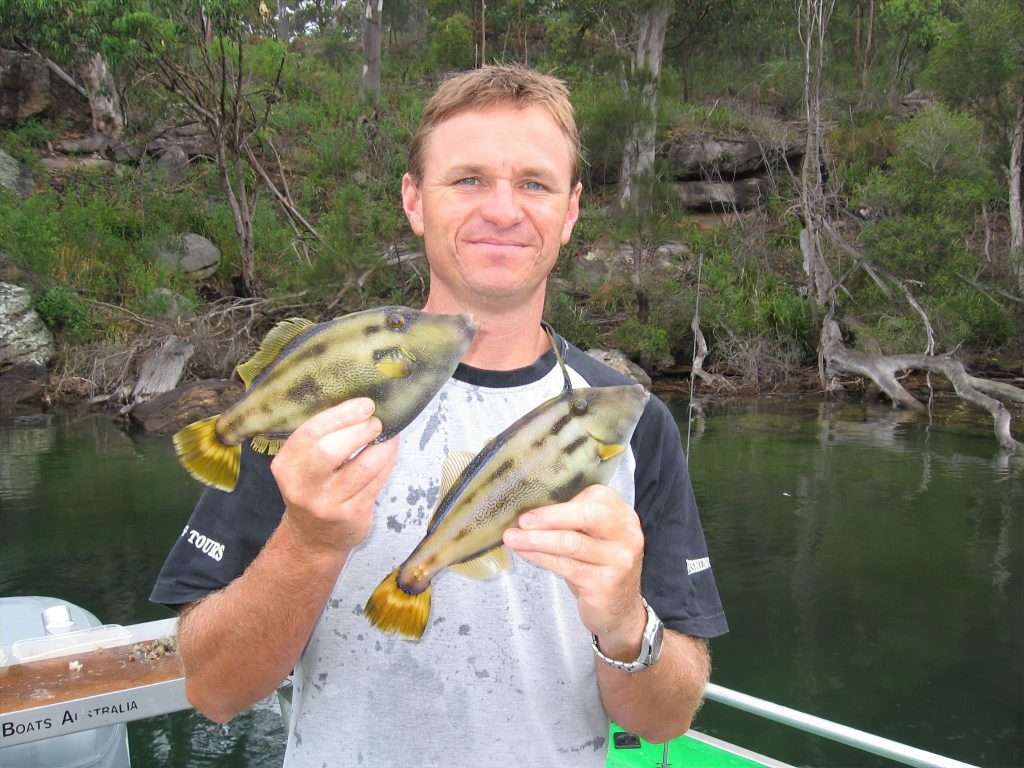
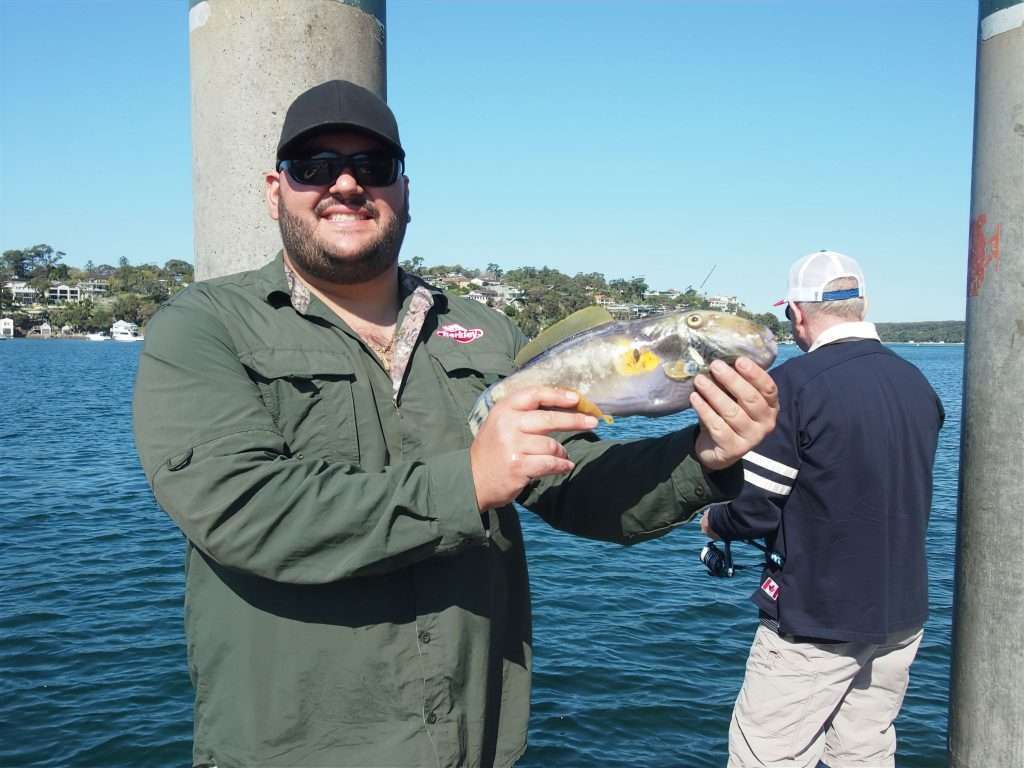
At times leatherjackets can be the scourge of both the estuary and off shore angler. They have been known as bait stealers and the piranhas of the sea. Many a time I have been fishing in one of the many estuary systems that I fish, only to have either my well-presented bait or soft plastic devoured by those pesky leatherjackets. Many an off shore angler will pull their hair out when they keep losing rig after rig after the leatherjackets have nipped the line, where a skerrick of bait has been left on the line.
I can remember as a kid, my dad taking me on the weekend for a fish chasing leatherjackets underneath the Tom Ugly’s Bridge at Blakehurst in Sydney. We use to spend a few hours sitting on the edge of an overhanging rock pulling in fan belly, yellow-fin and chinaman leatherjackets while using hand lines on either Coke bottles or cork with a paternoster rig and small pieces of peeled prawns.
Now days I prefer to use a rod and reel outfit off the shore or out of a boat. Over the years I have found that the trick to catching leatherjackets is to keep it very simple and the best rig that I have found that works is the paternoster rig.
Leatherjackets are extremely masterful at getting the bait off your hook without you feeling a thing. Think back to the times when you have been fishing for other fish species and all you have come back up with is the prawn shell, with no prawn meat inside or the squid bait that you have so carefully put on has now going without even feeling a bite.
Whether you are fishing off shore or in the estuaries for leatherjackets there are a few tricks you need to have up your sleeve. Keep the bait size small, use a fast tapered outfit, make sure the leader length from the mainline is short, always feel the sinker weight by having it off the bottom, have your finger on the line for feel, watch the rod tip and don’t forget to berley.
Get all this right and you will go home with a feed of leatherjackets.

PREFERRED OUTFITS.
- Estuary off the shore or off a wharf – Okuma Inked Egi Special INK-822M, Medium, 8’2″, 2 piece. This rod has a slow tapper allowing you to feel the light bites and it gives you a bit of a cushion when the fish tries to get away. This is them matched with an Okuma Ceymar 40 HD threadline reel and spooled with 10lb Platypus Pulse line.
- Estuary out of a boat – Okuma LRF Spin Rods – Full Grip, 6-feet – 6-inch, 1 to 3kg rod matched with an Okuma Ceymar 30 HD reel spooled with Platypus Pulse 6lb 4X braid.
- Offshore – Okuma Azores Z-S-702M, Medium, 7’0″, 2 piece, 8-12kg rod matched with an Okuma Azores ZXP-6000H threadline spooled with Platypus Pulse 15kg 4X braid.
TERMINAL TACKLE.
Hook types for the estuary would range from size 8 to 12 long shank and size 1 to 3/0 Owner circle hooks for off shore. The sinker size will depend on whether you are fishing where there is current or no current and the depth of the water. All you need to remember is that there must be a slight bend in the tip of the rod and the sinker is just off the bottom.
I always use a swivel when connecting the fluorocarbon leader to the braid mainline. Whether you use swivels or a knot for the leader. I will leave that up to you. As for me I prefer to use either a spider hitch or a dropper loop.
BAIT.
When targeting leatherjackets in the estuaries or bays you could try using small pieces of prawns, squid, octopus’ legs and tube, beach, blood and squirt worms. If using pieces of fillets, you will also need to keep the baits small (enough to just sit in the bend of the hook), but before using I would salt your tailor, pilchards, tuna, yellowtail, mullet or slimy mackerel.
Now, as for targeting leatherjackets off shore you could use just about anything as bait. Try lightly salting your bait down for a couple of days before you use it. This will help toughen up the skin and the flesh while still keeping in the juices that you need to attract the leatherjackets.

RIG.
When chasing leatherjackets, the main thing I found when using this rig is that you need to keep the overall length of the rig to about half the length of the rod that you are using and the keeping distance that the hook is away from the main line is no more than 12cm. Having it short will allow you to feel the bites much more easily.
Sure, you could use a sinker down onto the swivel and then a short leather, but I have found that the paternoster rig is the best by far.

TECHNIQUES
Technique No 1.
One thing you will need to remember when targeting estuary leatherjackets, they all have very small mouths and a set of teeth that would put a parrot to shame. Due to this you will need to use small gaped hooks (No 8’s to No 12’s) with a long shank. The bait size will only need to cover the bend of the hook; there is no need to run it up the shank.
Technique No 2.
When targeting estuary leatherjackets, I will always use a paternoster rig in either a single or double hook rig. The sinker weight is heavy enough to put a slight curve in the rod tip. Once I have baited up, I will fold over the bail arm, allowing the sinker to hit the bottom. When the sinker has hit the bottom, I immediately wind up the slack and allow the sinker (which is now just off the bottom) to put a slight curve in the rod tip. It is then just a matter of waiting for the leatherjacket to bite and then striking upwards to hook the fish.
When you feel the weight of the leatherjacket you will need to keep the rod tip up, only lowering it when the leatherjacket tries to swim off. I use this technique while not have any drag on my reel.
Technique No 3.
As stated, before I will only use a paternoster rig when chasing leatherjackets. The main thing to remember when using this rig is that you need to keep the length of the rig to about half the length of the rod you are using and that the distance that the hook is away from the main line is no more than 12cm. Having it short will allow you to feel and or see the bites much more easily.
Technique No 4.
If I am fishing offshore and targeting chinaman, six spine and reef leatherjackets I will still only use a paternoster rig (same as technique 3), but my hook size will vary from No 2 to 2/0 long shanks. If I am at anchor, I will use technique No 2, but if I am drifting, I will allow the sinker to hit the bottom and then engage to bail arm or drag taking up the weight. Then depending on how fast I am drifting I will let out some line so that the sinker once again reaches the bottom.
Technique No 5.
When I am anchored up and targeting leatherjackets in either fast or slow running water, I will use berley to attract them too directly under the boat. To do this I will cut up pilchards, squid, prawn heads and shells into very small pieces. I will then mix this up with damp sand and make them into a ball (somewhere between a golf and tennis ball). If the tide is slow, I will just drop them at the front of the boat, but if the tide is moving fast I will through the ball about 3 metres in front of the anchored boat. This will allow the berley to get to the bottom underneath your boat and to where your rig will be.
LOCAL SPECIES
I did a bit of research to find out how many different leatherjackets can be found in Australian waters. To my surprise I found twenty-six. Yes, twenty-six! They are listed below with their common name, scientific names and where found. Have you caught any of them?
| No | Common name | Scientific name | Where found |
| 1 | Bridled | Acanthaluteres spilomelanurus | Common in estuaries and coastal bays of Australia’s southern half from Fremantle in the west to Sydney in the east |
| 2 | Black reef | Eubalichthys bucephalus | Broughton Island in NSW & around the bottom half of Australia to Houtman Abrolhos in WA. |
| 3 | Blue-lined | Meuschenia galii | Inhabits coastal reefs from Port Phillip Bay in Vic to Houtman Abrolhos in WA. |
| 4 | Blue-tailed | Eubalichthys | Coastal refs of southern WA. |
| 5 | Brown Striped | Meuschenia australis | Inhabits coastal reefs from Wilson’s Promontory to Robe on SA, plus parts of Tasmania. |
| 6 | Chinaman | Nelusetta ayraudi | From North West Cape in WA and right around the bottom half of Australia and up to Cape Morton in Qld. Also found in Tasmania. |
| 7 | Degen’s | Thamnaconus degeni | Inhabits deepwater areas off Australia’s south coast from Wilson’s Promontory and across to Margaret River in WA. |
| 8 | Dusky | Paramonacanthus otisensis | South-eastern Qld to Sydney. |
| 9 | Fan-belled | Monacanthus chinensis | Geographe Bay in WA and northwards through tropical waters and then as far south as Narooma in NSW. |
| 10 | Gunn’s | Eubalichthys | Coastal reefs of TAS., Vic. & SA. |
| 11 | Horseshoe | Meuschenia hippocrepis | Coastal reefs from Wilson’s Promontory, northern Tas. & over to Houtman Abrolhos in WA. |
| 12 | Large Scaled | Cantheschenia | Sheltered coastal reefs in Northern NSW & Bass Point in NSW. |
| 13 | Mimic | Paraluteres prionurus | South-east Qld to Merimbula in NSW. |
| 14 | Mosaic | Eubalichthys mosaicus | Inhabits deep offshore waters of Australia’s southern half. |
| 15 | Pygmy | Brachaluteres jacksonianus | Moreton Bay in Qld & around the bottom half of Australia and up to Lancelin in WA. |
| 16 | Prickly | Chaetoderma penicilligera | Geographe bay in WA & around the top half of Australia & down to Sydney. |
| 17 | Rough | Scobinichthys granulatus | Shark Bay in WA &southern waters all the way around to Torres Strait in Qld. |
| 18 | Six-spined | Meuschenia freycineti | From Jurien Bay in WA to Wilson’s Promontory, including Tasmania and then from eastern Vic to Broughton Is in NSW. |
| 19 | Spiny-tailed | Bigener brownii | Coastal bays and estuaries from Qld to Sydney |
| 20 | Stars and stripes | Meuschenia venusta | Inhabits deep offshore waters of Australia’s southern half. |
| 21 | Toothbrush | Penicipelta vittiger | Inhabits coastal reef and weed areas from Coffs Harbour in NSW to Jurien Bay in WA. Also found in Tasmania. |
| 22 | Unicorn | Aluterus monoceros | Tropical species, but can be also found in northern NSW, Garden Island off Fremantle and Sydney. |
| 23 | Velvet | Parika scaber | Deep waters off Sydney & around the southern half of Australia to Cape Naturaliste in WA. |
| 24 | Yellow-eyed | Pervagor | Inhabits offshore reefs of northern NSW & down to Bermagui in NSW. |
| 25 | Yellow-finned | Meuschenia trachylepis | Moreton Bay in Qld to Lakes Entrance in Vic. |
| 26 | Yellow-striped | Meuschenia flavolineata | Coastal reefs from Broughton Island to Dongara in WA. |
This feature was inspired by a popular Fishing Monthly article by Lee Rayner back in 2007. Lee’s old text was unfortunately lost to time, but Gary Brown generously offered to replace it with his own take on these much-maligned (but tasty) fish.


